
Drug Drops

You’ve probably heard of Keytruda before. It’s one of those drugs that you see in commercials—like Ebglyss, Xeljanz, or Skyrizi—but it’s also an extraordinarily effective immunotherapy treatment for cancers. Over the last decade, Keytruda has played a key role in drastically increasing the survival rates of people with advanced melanoma. At the same time, Keytruda, like so many other life-saving drugs, is unbelievably expensive.
In 2026, the sticker price of one year’s worth of Keytruda is $210,000. Even for Americans inured to the high price of healthcare, this is a jaw-dropping amount. While all Americans have benefitted from Keytruda and other immune checkpoint inhibitors (ICIs), those who lack health insurance have seen fewer gains.
So far, this story sounds eerily familiar: transformative medical advancements that are inconsistently applied, leaving the full scale of benefits unrealized. I’ve already written about other instances of this; we’ve made brilliant strides on tackling malaria, sickle cell anemia, and AIDS, but some of the newest and most promising innovations have yet to scale because of high prices.
Sickle Cell Disease And The Era Of CRISPR

I first heard about sickle cell while watching ESPN. The anchor had just reported that Ryan Clark, a Pittsburgh Steelers safety, would not be playing in Denver that weekend. Several years earlier, after also playing in Denver, Clark needed surgery on his gallbladder and part of his spleen due to complications from his sickle cell trait. Sickle cell trai…
Politicians have—at least rhetorically—demonstrated they understand there’s a problem. The Biden administration capped insulin copays at $35 a month for Medicare users, and forged deals with insurance companies to lower the costs of ten drugs. Trump has made his own claims to lower drug costs, but his signature legislation kicked millions of Americans off their health insurance plans, so he gets no marks here. But despite overtures real and feigned, the problem of lower drug costs appears somewhat intractable—just like most other affordability issues.
Keytruda is a different story. In 2028, key patents that Merck holds in Keytruda will expire. This opens up opportunities for other drug manufacturers to create generic versions of Keytruda. For Merck, this is a large problem; Keytruda accounts for nearly half of its revenue. But for ordinary consumers, this is an extraordinary boon. Increased competition in the drug market at the end of drug exclusivity routinely leads to falling prices. Take Humira, a biologic drug like Keytruda, the price of which dropped around 30% soon after the end of patent expiration as generic drugs flooded the market. The higher revenue the drug—and Keytruda is the best selling drug in the world—the more competitors enter the market, and the more prices fall.
Happily, Keytruda is not a unicorn. A cascade of generic drugs will soon come to market as some massive drugs, like Eliquis, Gardasil, and Trulicity lose patent protections. A few years after, GLP-1s like Ozempic and Mounjaro will meet the same fate. This patent cliff is unprecedented in size. Between 2025 and 2033, $400 billion in revenue will lose patent rights. The last sustained patent cliff around 2011 was barely more than half that. Some of the drugs with patents soon to expire are small molecule instead of biologic, and these types usually see price falls closer to 80-90%.
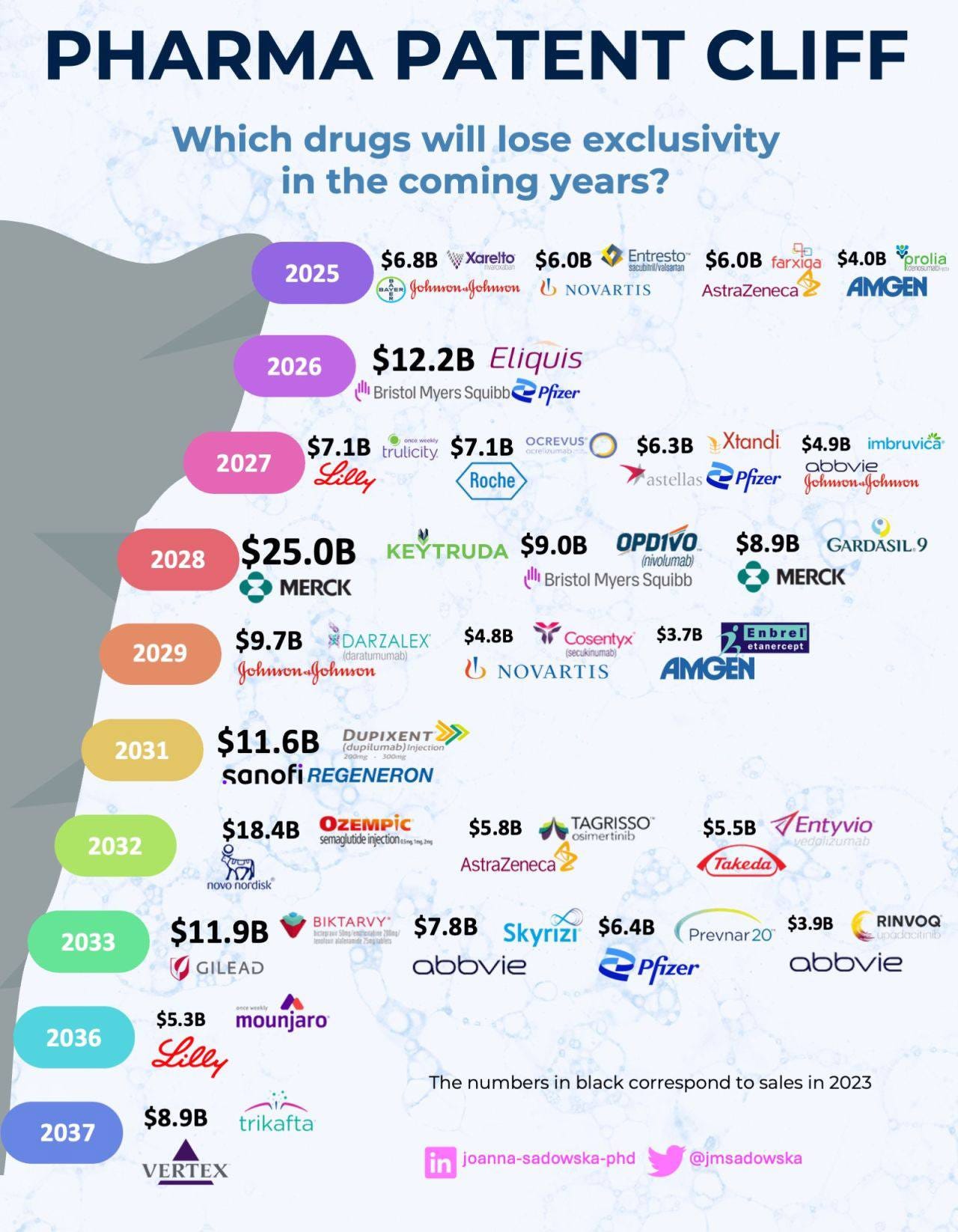
The mechanism behind this approaching cliff is something of a devil’s bargain: when a new drug is created, the holder of the patent typically has exclusivity for about 20 years. In that time, pharmaceutical companies earn insane profits, before steep drops once they reach the cliff. In order to combat losses in revenue, they are forced to innovate once more, creating better drugs in turn. In Merck’s case, that has meant buying other pharma companies, like Verona Pharma for $10 billion. In fact, biotech mergers and acquisitions are on the rise as companies look to counter the effects of the patent cliff.
There’s a serious dilemma that the patent system introduces. On the one hand, it serves as an incentivizer for innovation. Research and development is an expensive enterprise, and requires significant projected outlays in order to math out. Once, Europe was the unquestioned innovation leader in biotech, creating more than half of all new drugs. But as they installed cost controls, both the volume and the speed of drug development declined, and the US took up the mantle as the world leader. The result hasn’t just been profits for a few companies, but comparatively fewer drug shortages and access issues compared to those experienced in Europe.
On the other hand, any system where a company has 20 years to sell life-saving drugs at unfathomable prices needs significant retooling. If we ignore cost controls as an unsustainable, if attractive option, there remain other solutions.
A popular idea is the patent buyout, where the government would essentially pay a company for its patent at market value and then release it into the public domain. This serves as a carrot, rather than the stick of forcibly lowering drug costs, and continues to incentivize new drug creation while also allowing the government to end patent exclusivity and bring it to market early. The propagator of this idea cites the Daguerrotype as an example; in the 19th century the French government bought the patent for this precursor to the camera, and then gifted it to the French public.
Another idea to improve the patent process is a Harberger Tax, which is a type of self-assessed tax. On the face of it, if someone has the ability to assess the value of their own property, it’s likely that they’ll undersell it to pay less in taxes! But a Harberger Tax includes a second provision: said property can be bought at that assessed value. Apply this to patent law, and companies either assess their patents cheaply, increasing the risk of them being purchased, or pay higher taxes—which can then be used to fund other patent purchases. Georgists have also suggested reducing the length of a patent from 20-years to five, with a yearly auction to determine who has rights for that year.
These all sound like compelling ideas, and perhaps implementation of them would meaningfully lower the healthcare costs that plague millions of Americans. In the interim, we might take some comfort in the knowledge that the greatest patent cliff in history is here and a number of crucial, life-saving drugs are about to become much, much cheaper. It might seem like a small victory, but it is a very big deal for each and every person who uses these drugs.